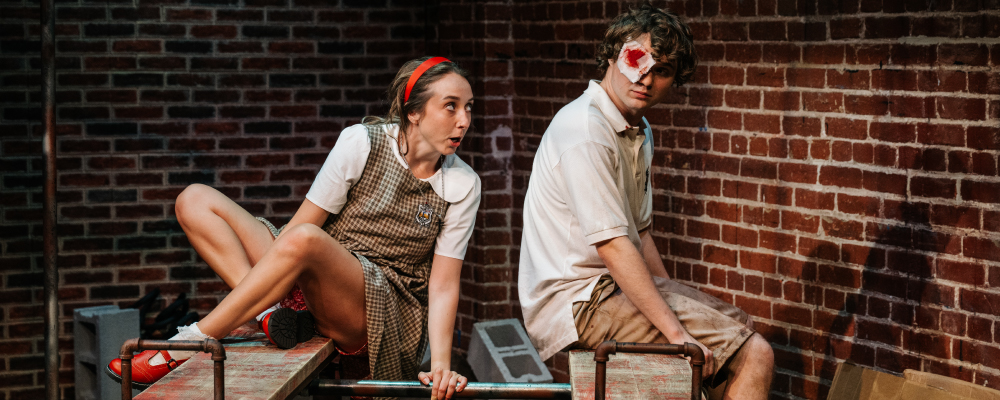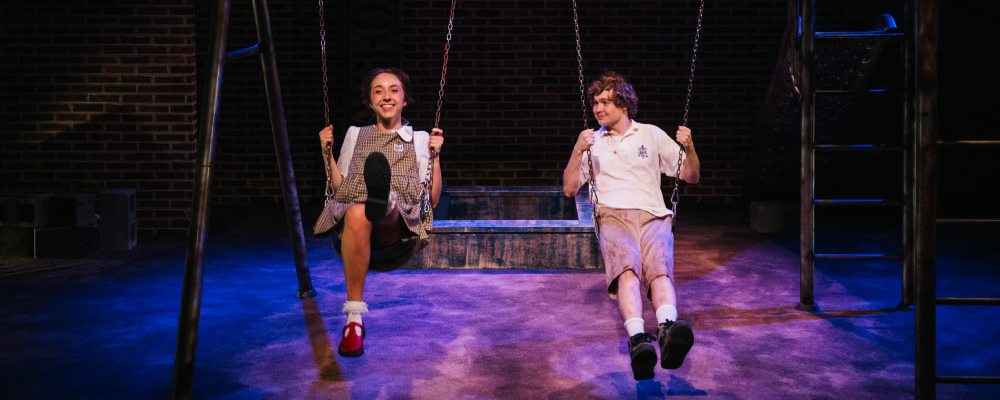
 There’s something special about a show that reaches its satisfying climax as a bunch of teenagers jump around the stage, gamely singing, “Blah blah blah blah blah blah blah blah blah blah blah blah blah.” Then again, nothing about Spring Awakening, Duncan Sheik’s masterful ode to teen angst, screams “conventional musical.” Composer Sheik and author/lyricist Steven Sater won eight Tony awards back in 2007 for the show, a work that manages to perfectly capture the ecstatic highs and the miserable lows of confused, hormonal teenagers who are discovering their sexuality and intellectual independence in spite of the repressed and restrictive adults around them. Though the musical feels thoroughly contemporary, it’s actually based on a then-scandalous 1892 German play of the same name by Frank Wedekind. Keegan Theatre is the first DC company to stage its own take on the show (the national tour stopped at the Kennedy Center back in 2009), and the company has delivered a rousing rendition.
Spring Awakening revolves around a chorus of teenagers, with a particular focus on three individuals: Melchior, a defiant young intellectual (Vincent Kempski); the naive but curious Wendla (Ali Hoxie); and the struggling student Moritz (Paul Scanlan). The parents’ attempts to stifle not just their children’s sexual expression and creative thinking, but any knowledge of the realities of adulthood, have dire consequences. The atmosphere of hope and rebellion that pervades act one descends into tragedy when act two comes around.
Spring Awakening’s songs can be haunting and poetic, and some stand alone as thrilling anthems against authority. One of the strengths of the Keegan production, from directors Mark and Susan Marie Rhea, is the way its smaller ensemble players manage to shine even if they have just a snippet or two of solo vocal time. This happens in such numbers as the playful and dreamy “My Junk,” as well as the stirring “Touch Me.” Kurt Boehm’s choreography, which drives the energy of ensemble numbers like “The Bitch of Living,” is reminiscent of the Broadway production, at times jumpy and jerky but often lyrical and balletic, as well.
Kempski gives a rock-star performance as Melchior.”
His charisma is on full display during “Totally Fucked” (the aforementioned “blah blah blah” song), in which, amidst a chorus of his peers, he realizes he’s backed himself into a corner. Kempski also offers a tender, tearful rendition of “Left Behind,” a eulogistic ode to a fallen friend (it’s a challenging song vocally that Kempski manages to sing through his sobs).
 The heart of Spring Awakening lies with Moritz, and Scanlan brings a punk sensibility to such numbers as “And Then There Were None,” though he stumbled over a few lyrics Tuesday evening. Sarah Chapin and Nora Palka are responsible for one of the play’s most chilling scenes, the moody duet “The Dark I Know Well,” during which each confesses the same terrible secret.
From abortion to incest to suicide, Spring Awakening doesn’t shy away from heavy, edgy themes. The show closes with “The Song of Purple Summer,” a beautiful, soaring ballad that presents imagery of springtime and new beginnings (“The fences sway. The porches swing. The clouds begin to thunder, crickets wander, murmuring.”). In the show, the song feels like it comes out of nowhere, tacked on after the story has wrapped up one depressing turn after another. But it does offer an optimistic sense that despite all that’s transpired, maybe, just maybe, the kids are all right.