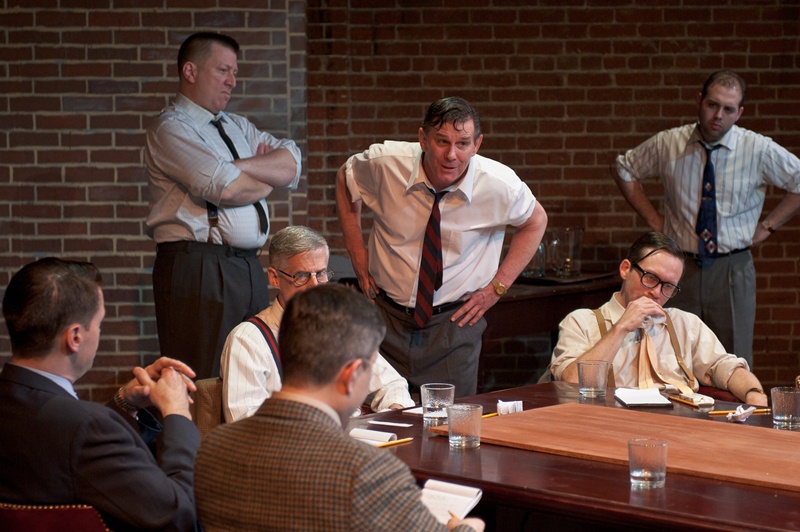
 While the show currently playing at Keegan Theatre is official titled Twelve Angry Men, that might be a bit misleading—in a courthouse jury room stifling with testosterone and late summer heat, Juror Number Eight remains calm, collected, and incessantly reasonable. Colin Smith takes on the lone dissenting vote and iconic role in playwright Reginald Rose’s tense legal drama with the thoughtfully furrowed brow and soft-spoken steadiness necessary to sway his stubborn fellow jurors (and the audience) to question their assumptions. And for a play that relies on little more than a dozen actors, a table, and Rose’s rich script, casting Smith in the pivotal part is a convincing opening argument.
Overall the cast, under the direction of Christopher Gallu, delivers the deeply human chemistry and emotional evolutions the script calls for…”
Originally written as a live teleplay in 1954 and later presented as a play and a 1957 feature film (with Henry Fonda as Juror Number Eight), Twelve Angry Men has long been admired for its minimalist structure and timeless, character-driven lessons about groupthink, prejudice, and justice. Those lessons come through here, though not always as powerfully as they could. The life of a 19-year-old boy charged with his father’s murder rests in the hands of the 12-man cast as the play opens, and the irritable and overheated jurors seem to have already set their minds on a guilty verdict. But when a preliminary poll reveals one juror isn’t convinced, the deliberations start their dramatic build. Personal biases are called into question, along with truth, the wisdom of standing up against the crowd, and the sacred meaning of “reasonable doubt.”
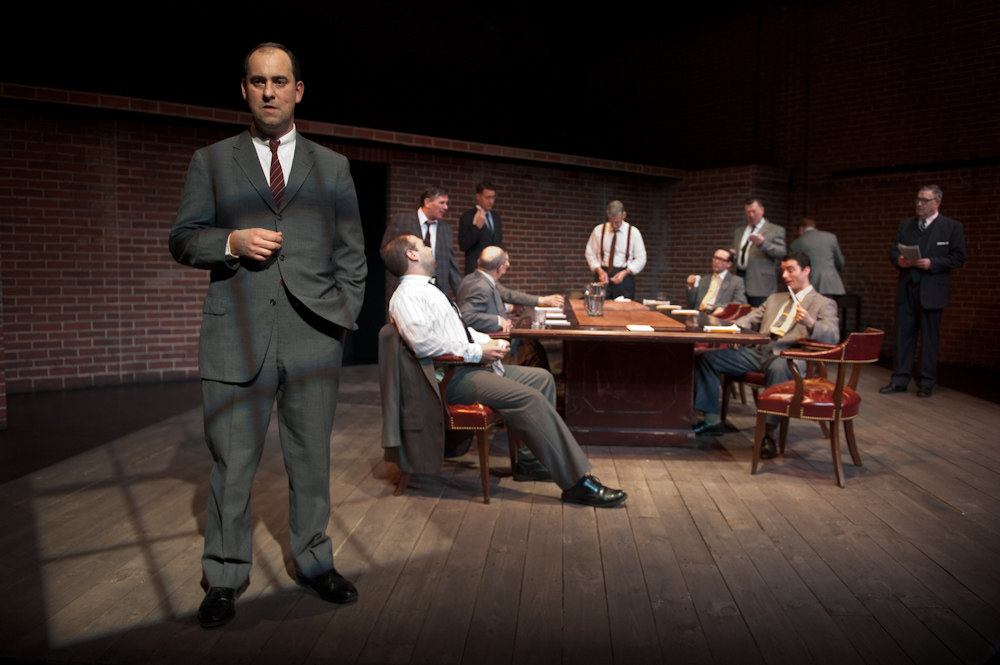 Not surprisingly, when you lock 12 grown men with passionately divergent opinions into a stuffy space and ask them to come to a peaceable agreement, things are bound to get heated. Here, a perfectly red-faced Juror Number Three (a nuanced David Jourdan) leads both the charge against Eight’s inconvenient uncertainty and the cast, talent-wise. Jourdan’s bluster is organic and controlled, and his fiery tirades seem fueled by believable life experience rather than theatric impact. Other standouts include the stern but principled Juror Number Four (Kevin Adams) and Richard Jamborsky, a real-life former juvenile court and trial judge of more than 30 years, as the elderly Juror Number Nine, the first of the group to be persuaded to change his vote.