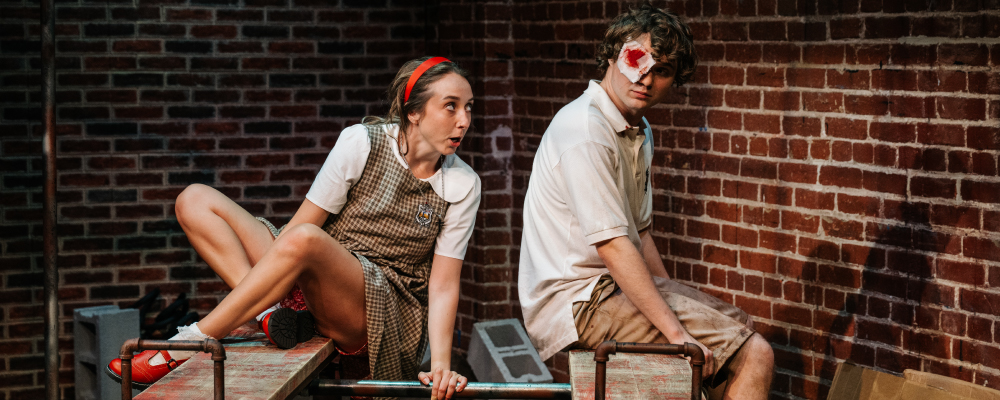
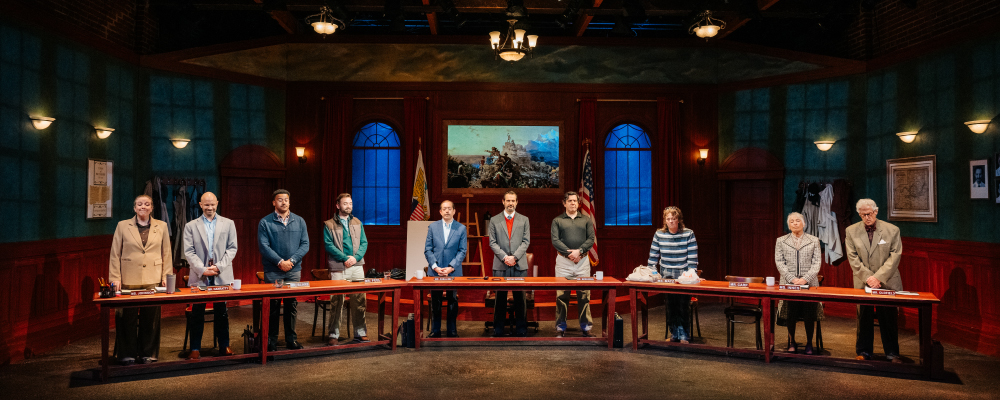
Tracy Letts’s “The Minutes” excels at skewering institutional power and exposing the tribalism that enables it. The cutting satire, a 2018 Pulitzer Prize finalist and 2022 Tony nominee, revels in the dizzying decorum that keeps much of anything from getting done in small-town government. But it’s clear that Letts has more on his mind. Moral betrayals. Truth-quashing indiscretions. Cultlike devotion. Brazen whitewashing.
By the time you realize you’re actually witnessing surrealist horror in the Keegan Theatre’s blistering D.C. premiere, there’s no doubt that the call is coming from inside the house. What a time and place for a sobering commentary on how power can corrupt the innocent and protect the guilty.
Centered on a city council meeting in the indistinct town of Big Cherry, USA, “The Minutes” at times feels ripped from D.C. headlines. The proposal to host a mixed martial arts extravaganza called “Lincoln Smackdown” reads like parody that, amid plans for such an event on the White House lawn, manifested itself into existence. The play’s talk of erecting an unnecessarily lavish monument also strikes an uncanny chord amid current conversations around a certain triumphal arch.
The prescience stresses the incisiveness of Letts’s text, sharply shepherded by director Susan Marie Rhea and a top-notch cast. Stephen Russell Murray exudes everyman charm as Mr. Peel, a wet-behind-the-ears council member trying to discover what unfolded when he missed the previous week’s meeting. (The minutes from that gathering are missing, and one council member’s seat is suddenly empty — until, in a clever coup of structure and staging, it isn’t.) Ray Ficca daunts as the two-faced mayor. Theo Hadjimichael and Zach Brewster-Geisz are sufficiently sketchy as a couple of steamrolling council members. Timothy H. Lynch wins many a laugh as a cantankerous council veteran of questionable lucidity.
Then there’s Valerie Adams Rigsbee’s dutiful clerk, who emphasizes the stakes when information that could upend the community’s collective identity comes to light. “We live here,” she pleads. “This is where we live.” In a city uniquely shaped by the powers that be, the line stings with uneasy recognition.